5.0 · 82 Google reviews
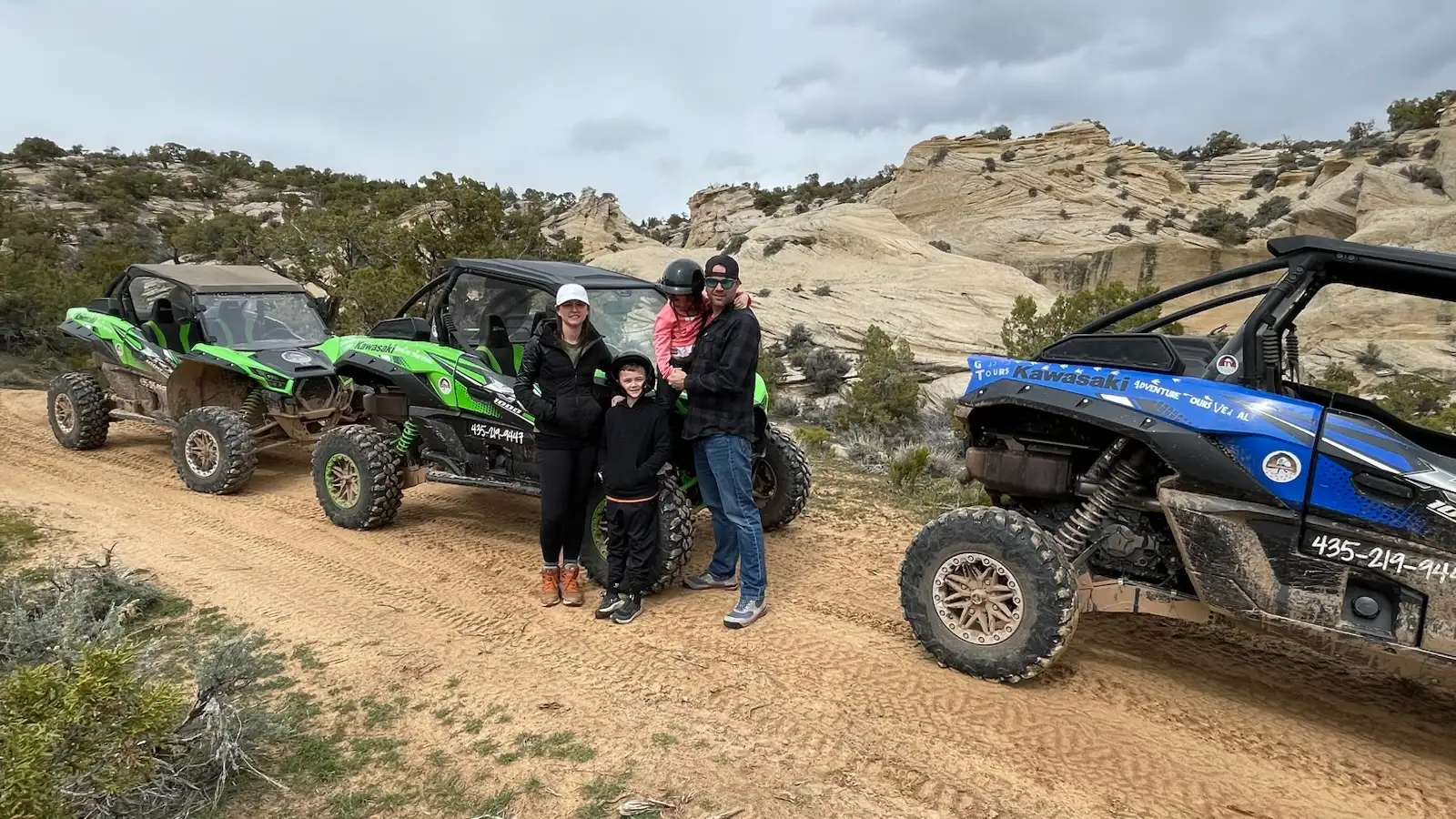
Who This Guide Is For
If you’ve never driven anything off-road, if the words “side-by-side” and “UTV” are new to you, or if you’re excited by the idea but quietly nervous about whether you can actually do it — this guide is written for you. After years of guiding first-time riders through the canyons and washes around Vernal, we can tell you plainly: the vast majority of people who book a tour have never driven off-road before, and they finish grinning.
This isn’t a sales pitch. It’s an honest walk-through of what a guided UTV tour actually involves, so you can decide with confidence whether it’s right for you, your partner, your kids, or your parents. We’ll cover what the machines are like, what happens minute to minute, what to do if you get nervous, and every common beginner concern we hear at the staging area.
Key Takeaways
- No experience is required. Guided tours are built for beginners. If you can steer and press a pedal, you can do this.
- You are never on your own. Dave and Trudy Wilson personally guide every tour and ride alongside your group the entire three hours.
- The machines are forgiving. The Kawasaki KRX 1000 has automatic transmission and power steering — there’s no clutch, no gears to shift, and no fighting the wheel.
- You don’t have to drive. A $125 ride-along option lets nervous or reluctant guests experience the full tour as a passenger.
- Every tour starts with instruction. A full safety briefing covers the machine and the trail before you move an inch.
- The pace is yours. Tours are set to the comfort of the least experienced rider — relaxed and scenic, or a little livelier, entirely up to your group.
- It suits nearly everyone. Couples, families, first dates, and multi-generation groups all ride together. Drivers must be 18+; passengers can be as young as 2. (VERIFY WITH OFFICIAL SOURCE for any specific medical, mobility, or licensing questions.)
- Booking is simple. Pick a date, pick a trail, and we handle the rest. $349 per machine for a 3-hour tour with up to 2 riders. Call (435) 219-9447.
Why Beginners Love Guided Tours
The single biggest reason first-timers have a great time is also the simplest: they don’t have to figure anything out. When you rent a machine on your own, the adventure comes with a to-do list — find a legal trail, read the terrain, judge your own limits, hope you don’t get lost where there’s no cell service, and deal with anything that goes wrong by yourself. That’s a lot of pressure for someone who just wanted to try something new. A guided tour removes every one of those unknowns and leaves only the fun part.
On a guided tour, the hard decisions have already been made by people who’ve made them thousands of times. Dave and Trudy built these routes, know every rock and overlook, and read the trail conditions so you don’t have to. Your only job is to drive your machine at a comfortable pace and enjoy the scenery — the canyon walls, the petroglyphs, the hidden arches, the Wild West history. The expertise is included; you just show up.
Beginners also love that the experience is genuinely social and unhurried. This isn’t a race or a follow-the-leader convoy. Dave and Trudy stop at overlooks, explain what you’re looking at, answer questions, and give you time to take photos. Nervous riders get patience and encouragement; confident riders get room to enjoy the machine. Because the group is small and private — never mixed with strangers — the whole tour flexes to fit the people on it.
And then there’s the terrain you’d simply never reach alone. The best backcountry around Vernal has no signs, no marked trailheads, and no easy way in without local knowledge. A guide is the key that unlocks it. Beginners get to see the canyons, arches, and outlaw country that experienced riders spend years learning to find — on their very first day.
Guided Tour vs. Riding Alone
| Guided Tour | Renting & Riding Alone | |
|---|---|---|
| Experience needed | None — built for beginners | You judge your own limits |
| Finding the trail | Done for you by local guides | Up to you; trails are unmarked |
| Safety instruction | Full briefing before every tour | On your own |
| If something goes wrong | Guides are right there | You handle it, often with no cell service |
| Local history & scenery | Pointed out and explained | Easy to ride right past |
| Pace | Set to your comfort level | Entirely self-managed |
| What’s included | Machine, guide, helmets, gear | Machine only |
| Best for | First-timers, couples, families | Experienced riders with their own plan |
Is This Right for You?
The honest answer for most people is yes — but the tour looks a little different depending on who you’re riding with, so it’s worth picturing yourself in it.
Couples. A shared machine makes this one of the easiest adventures to do together. One person drives, one rides shotgun, and you trade off so you both get the wheel and both get to just look around. Couples tend to gravitate toward the scenic trails — Moonshine Arch is a perennial favorite for the hidden-arch payoff and the photos. If you’re building a whole trip around it, our Romantic Weekend in Dinosaur Country itinerary shows how a tour fits into a longer getaway.
Families. Because passengers can be as young as 2 and drivers must be 18 or older, a family can span three generations on the same tour. Parents drive, kids and grandparents ride along, and everyone’s on the same trail at the same time. If your group is larger, our group UTV tours are built for exactly that — and the 2-Day Family Itinerary maps out how to pair a tour with the rest of Dinosaur Country.
Friends. A few friends who’ve never done this before make for the most relaxed group of all — nobody’s an expert, so nobody feels behind. It’s a low-pressure way to try something new together and come home with a shared story.
Older adults. Power steering and the roll cage make the KRX 1000 approachable well beyond the “young thrill-seeker” stereotype, and the ride-along option removes driving from the equation entirely for anyone who’d rather sit back. Comfort varies from person to person, so for specific mobility or health questions, VERIFY WITH OFFICIAL SOURCE by calling before you book.
Couples vs. Families vs. Friends
| Couples | Families | Friends | |
|---|---|---|---|
| Typical setup | Share one machine, trade off driving | Adults drive, kids & grandparents ride along | One or two per machine, mix and match |
| Popular trail | Moonshine Arch (scenery) | Doc’s Beach (easy, forgiving) | Anything — often Outlaw Trail for the story |
| Best part | Doing it together | Three generations, one trail | Nobody’s the expert; all learning together |
| Good to know | Book a single machine | Confirm passenger ages when booking | Consider a group tour if 5+ |
What the Experience Is Really Like
Here’s what an actual tour feels like from a beginner’s seat, start to finish. You arrive at the staging area, meet Dave and Trudy, and get fitted with a helmet and safety gear. Before anyone moves, there’s a full safety briefing — how the machine works, how the controls feel, how to follow the guide, and what to expect on the trail. This is where most first-timers feel their nerves settle: the machine is simpler than they feared, and the people running the tour clearly do this every day.
Then you start driving, and the opening stretch is deliberately gentle — open, forgiving terrain where you get a feel for the throttle and the steering at low speed. By the time the scenery ramps up, so has your confidence. Dave leads and Trudy trails (or the other way around), so you’re bracketed by guides the whole way. You stop at overlooks and rock-art panels, hear the history, take photos, and catch your breath. Three hours sounds long on paper; most guests are surprised how quickly it goes.
The best way to know which version of this suits you is to decide whether you want to drive or ride along.
Driver vs. Ride-Along Passenger
| Driver | Ride-Along Passenger | |
|---|---|---|
| Who it’s for | Anyone comfortable steering a vehicle | Nervous riders, non-drivers, those who’d rather relax |
| Age requirement | 18 or older | As young as 2 (VERIFY WITH OFFICIAL SOURCE for specifics) |
| What you do | Operate the machine at your own pace | Sit back, watch, photograph |
| Cost | Included in the $349/machine (up to 2 riders) | $125 to ride with a guide |
| Can you switch? | Yes — trade off mid-tour | Yes — take the wheel if you feel ready |
What You’ll Ride
Every guest rides a Kawasaki KRX 1000 — a two-seat side-by-side built for exactly this kind of terrain. It has automatic transmission (no gears to shift), power steering (light and easy at the wheel), a full roll cage, and FOX 2.5 PODIUM LSC suspension that soaks up the bumps so the ride stays comfortable rather than jarring. From a beginner’s point of view, the important part is what it doesn’t ask of you: no clutch, no shifting, no technical skill to simply move down the trail at a relaxed pace.
The reassuring thing about the KRX 1000 is that the same machine serves a nervous first-timer and a seasoned off-roader equally well — the difference is entirely in how you drive it, not in what you have to master.
First-Time Rider vs. Experienced Rider
| First-Time Rider | Experienced Rider | |
|---|---|---|
| Learning curve | Minutes — covered in the briefing | Already comfortable |
| Pace | Relaxed, scenic, guide-led | Livelier on open straightaways |
| What the machine asks | Steer and go | Same machine, more input |
| Focus | The views and the history | The terrain and the drive |
| Guide’s role | Reassurance and instruction | Route knowledge and access |
If you decide you’d like more time on the machine, tours can be extended for $99/hour per machine — but three hours is plenty for a first outing. For a deeper look at the machines and the five trail systems, see the Ultimate Guide to UTV Riding in Vernal and our Best UTV Trails Near Vernal.
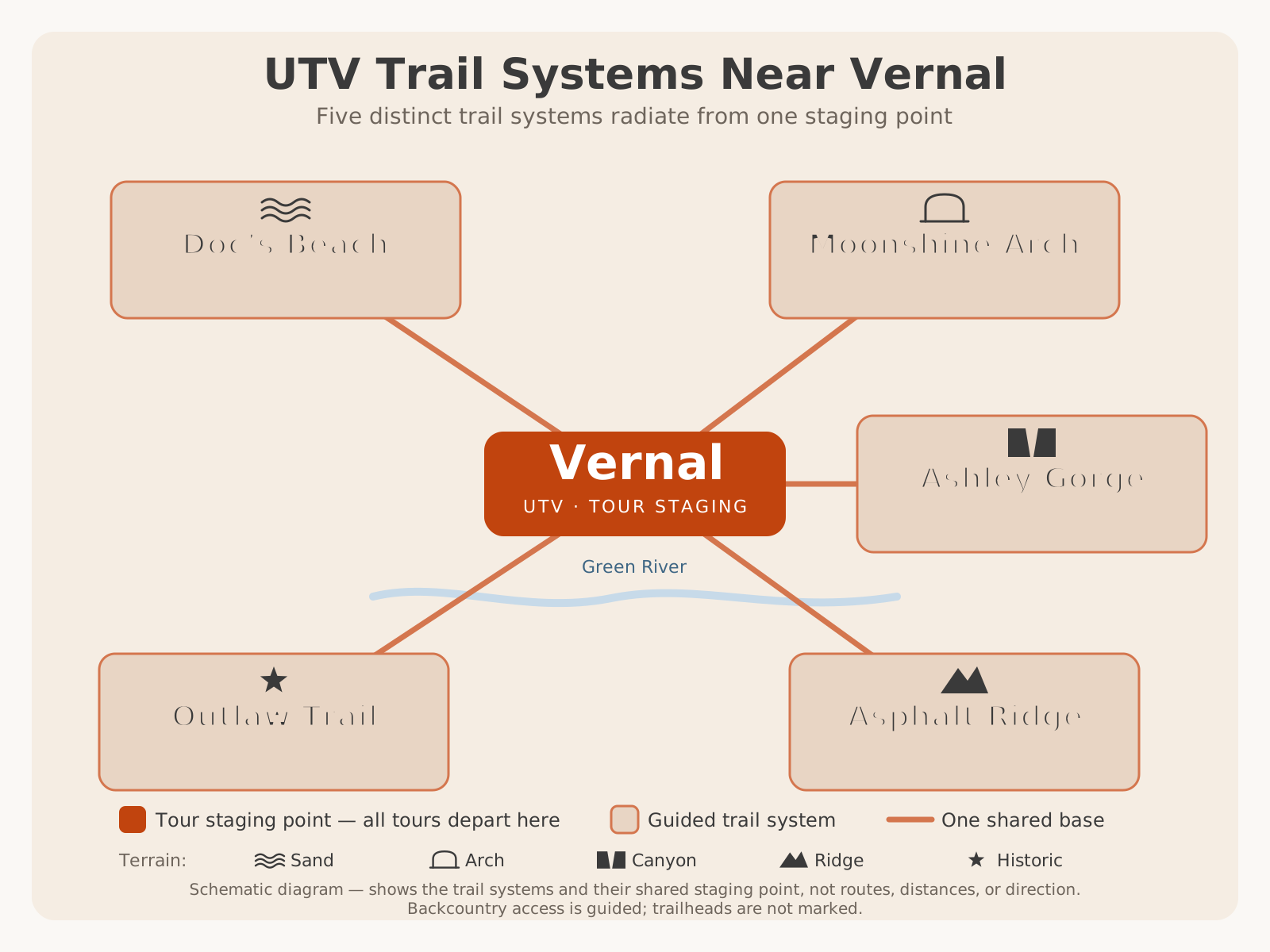
It helps to see how the five trail systems fit together before you pick one. All of them start from the same staging point in Vernal, and you simply choose your trail when you book — the diagram below lays them out at a glance.
Safety
Safety is the reason a guided tour is the right call for a beginner, not an afterthought. Every tour begins with a thorough safety briefing covering how to operate the machine before you drive it. Helmets and required safety gear are provided — you don’t need to own or bring anything. The KRX 1000’s full roll cage is standard equipment, and the power steering and automatic transmission remove two of the most common sources of new-driver mistakes.
Just as important, you’re guided the entire time. Dave and Trudy ride their own machines alongside your group, reading the trail and conditions so you don’t have to, and staying close enough to help immediately if anything comes up. Because much of the backcountry has no cell service, having experienced guides with you — rather than a map and a phone — is a genuine safety advantage, not just a convenience.
Off-highway-vehicle rules, helmet laws, and licensing requirements can change over time. For the current regulations that apply to your tour, VERIFY WITH OFFICIAL SOURCE when you book — and know that whatever applies, your guide walks you through it in the briefing.
What to Wear
You don’t need special gear, but a little thought makes the ride more comfortable. Closed-toe shoes are the one firm recommendation. Beyond that: comfortable clothing you don’t mind getting dusty, sunglasses, and layers — the high desert can be cool in the morning and warm by afternoon, so being able to add or remove a layer helps. Because desert weather is changeable, check current conditions and dress for the day rather than the forecast you saw last week.
For a full, season-by-season breakdown, see What to Wear on a UTV Tour and the Vernal Weather Guide.
What to Bring
The short version: bring less than you’d think, because the essentials are handled. Helmets and safety gear come with the tour. What beginners most often forget is sun protection (sunscreen, sunglasses, a way to keep a hat on), water to stay hydrated in the dry air, and a secured phone or camera for photos — a strap or zippered pocket matters more than you’d expect on the trail. Our complete What to Bring checklist covers everything so nothing surprises you at the staging area.
Common Beginner Concerns
“I’ll be the slowest one and hold everyone up.” You won’t. The tour is paced to the least experienced rider by design, and the group stays together on purpose. There’s no one to fall behind.
“What if I can’t handle the machine?” The KRX 1000 is built to be easy — automatic, power-assisted, forgiving. The briefing covers everything, and the opening stretch lets you practice at low stakes. If it ever stops being fun, you switch to riding along.
“Is the terrain going to be too extreme?” You choose your trail when you book, and options range from the easy, open Doc’s Beach to more rugged backcountry routes. Tell Dave your comfort level and he’ll match the trail to your group.
“I’m just not a thrill-seeker.” You don’t have to be. Plenty of guests come for the scenery, the history, and the quiet backcountry rather than adrenaline. A relaxed cruise with great views is a completely valid way to do this tour.
Beginner Mistakes to Avoid
A few small missteps come up again and again with first-timers — all easily avoided:
- Overdressing or underdressing for the desert. Skipping layers leaves you cold in the morning or overheated by afternoon. Check the weather guide and plan for the swing.
- Forgetting sun protection and water. The high desert is deceptively dry and bright. This is the single most common oversight — see What to Bring.
- Bringing an unsecured phone or camera. Loose items get bounced around on the trail. Use a strap or a zippered pocket.
- Assuming you must drive. If the idea makes you anxious, the ride-along option exists for exactly that reason. Don’t talk yourself out of the tour over it.
- Booking too late in peak season. May through October fills up, and only one full-fleet tour runs at a time. If your dates are fixed, book early.
- Wearing open-toed shoes. Closed-toe footwear is the one wardrobe rule worth honoring.